
Digital marketing is the use of websites, apps, mobile devices, social media, search engines, and other digital means to promote and sell products and services.
Digital marketing is considered one of the fastest-growing in-demand job skills today. In fact, digital marketing jobs are expected to increase by 67%—higher than the average job growth rate. By 2028, customer marketing managers and search marketing managers are listed among the fastest-growing jobs in the United States according to CNBC.
As a result, the traditional marketing approach is slowly being replaced by digital marketing. Now, gradually, all kinds of businesses are embracing this new form of marketing, as it has become a more powerful way to market any product or service.
If anyone wants to pursue a career in marketing, then obtaining a degree in digital marketing can be very useful for career growth.
India’s digital marketing industry is projected to grow at a CAGR of 30% between 2023 and 2030. In 2023, the industry was valued at $8 billion and is expected to exceed $20 billion by 2028.
63% of businesses have already increased their digital marketing budgets in recent years. On top of this, 94% of small businesses plan to increase their marketing spending in 2024. Between 2023 and 2024, there was a 10% growth rate in digital marketing budget spending across businesses.
What is Digital Marketing?
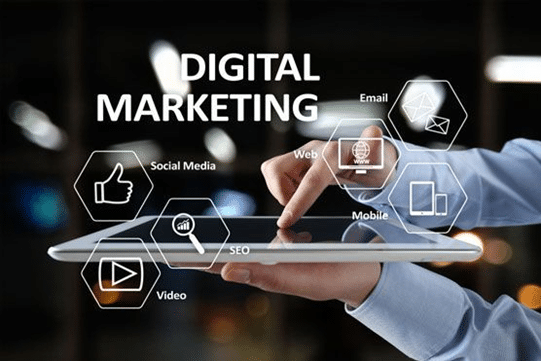
Digital marketing is the use of digital channels to market products, boost brand awareness, drive traffic, and achieve marketing goals. It helps brands connect with potential customers via the internet. Digital marketing takes many forms, including search engines, websites, social media, and email marketing.
In today’s world, almost everyone uses the internet. Businesses have shifted from traditional marketing (like newspapers, TV, and billboards) to digital marketing.
Why Businesses Switched from Traditional Marketing to Digital Marketing
There are a few reasons:
- Traditional marketing uses non-internet channels like TV, radio, and print media, while digital marketing uses online channels like social media, search engines, and email.
- In digital marketing, businesses can easily connect and interact with the audience, which is not easy in traditional marketing.
- In digital marketing, you get feedback from customers and improve your products and services according to their needs. This is not possible in traditional marketing, as it is difficult to forecast the current market demand.
- Traditional marketing is costlier than digital marketing.
- Traditional marketing is a more hands-on process than digital marketing.
Types of Digital Marketing
- Search Engine Optimization (SEO)
SEO, or search engine optimization, is the practice of increasing the quantity and quality of traffic to your website through organic (non-paid) search engine results.
The SEO industry has shown remarkable growth and resilience over the years. According to Acumen Research and Consulting, the global SEO services market was valued at $46.7 billion in 2021 and is projected to grow at a compound annual growth rate (CAGR) of 17.6%, reaching $234.8 billion by 2030.
There are a number of ways to approach SEO to generate qualified traffic to your website. They include the following:
a. On-Page SEO
On-page SEO refers to the optimization of a website’s individual pages to improve their search engine ranking and visibility.
Key on-page SEO factors include:
- Optimizing titles and meta descriptions
- Improving page speed
- Using keywords effectively in content
- Ensuring mobile-friendliness and responsiveness
It involves making changes to both the content and the HTML source code to enhance a page’s quality, relevance, and user experience.
b. Off-Page SEO
Off-page SEO refers to strategies taken outside of your website to improve its search engine ranking, authority, and credibility.
Key tactics for off-page SEO include:
- Building high-quality backlinks from other sites
- Engaging on social media
- Promoting content through outreach and mentions
- Ensuring your site is trustworthy and relevant
c. Technical SEO
Technical SEO involves optimizing a website’s technical aspects to make it easier for search engines to crawl, understand, and index your website.
It focuses on elements like:
- Site architecture
- Page speed
- Mobile-friendliness
- Structured data
It ensures that behind-the-scenes functionality doesn’t hinder a website’s ability to rank.
2. Social Media Marketing (SMM)
Social Media Marketing is the use of social media platforms to build a brand, increase sales, and drive website traffic through strategies like publishing engaging content, interacting with followers, and running targeted ads.
User growth
- In early 2024, there were about 5.04 billion active social media user-identities worldwide (62.3% of global population).
- In 2017, the number was 2.80 billion.
Ad-spend growth
Global social media advertising spend:
- 2017- US$ 51.32 billion.
- 2018- US$ 73.28 billion.
- 2019- US$ 97.50 billion.
- 2021- US$ 180.90 billion.
- 2024- US$ 244 billion (estimated)
That means ad spend has grown 4.7* from 2017 to 2024.
3. Website Development
Website development is the process of creating and maintaining websites and web applications. It encompasses everything from the visual design to the underlying code and functionality.
Experts predict the global Web Design Market will grow at a compound annual rate of 8.50% from 2024 to 2031. This is based on expectations that the market size revenue will reach US$56,815.2 million by the end of 2024.
4. Content Marketing
Content marketing is a strategic approach that uses valuable, relevant content to attract and retain a defined audience — building trust and engagement over time.
It involves creating and distributing content like blog posts, videos, and podcasts to guide potential customers through their journey and ultimately lead to profitable actions like purchases.
Global Content Marketing Market Analysis
The global content marketing market size was $413.3 billion in 2022 and is predicted to grow with a CAGR of 16.9%, by generating a revenue of $1,956.5 billion by 2032.
Why digital marketing is important?
- Cost-effective
- Measurable results
- Brand awareness
- Connecting with customers
- Customer engagement
- Effective targeting
- Influencers
- Social media marketing
- Cost efficiency
- Demand for digital marketers
- Email marketing
- Flexibility
- Global Reach
- Pay per click (ppc)
- Affiliate marketing
- Content marketing
- Digital marketing
- Huge customer base
- Improved customer experience
- Measuring success
- Return on investment
- Search engine optimization
- Select your digital marketing channels
- The evolution of digital marketing importance
8 Powerful Insights About its Future in 2025.
Digital marketing is evolving rapidly with advancements in technology and changes in consumer behavior. The future of digital marketing will be shaped by innovation, personalization, automation, and a greater focus on customer experience.
1. Artificial Intelligence (AI) and Automation
AI is revolutionizing digital marketing by analyzing data, predicting customer behavior, and automating tasks. Tools like chatbots, predictive analytics, and automated ad campaigns help businesses save time and deliver personalized experiences.
Examples of AI in marketing:
- AI chatbots for instant customer support.
- Automated ad targeting and performance optimization.
- Predictive analytics for customer insights.
2. Personalization and Customer Experience
Customers now expect highly personalized experiences. Marketers use customer data and behavior insights to deliver relevant content, recommendations, and offers.
- Personalized email campaigns.
- Customized landing pages and product recommendations.
- User-specific ads based on browsing history.
3. Voice Search Optimization
With the rise of voice assistants like Alexa, Siri, and Google Assistant, voice search optimization has become vital. Marketers need to use conversational keywords and natural language to rank higher in voice search results.
- Focus on question-based keywords.
- Use long-tail conversational phrases.
- Optimize for local voice searches (e.g., ‘near me’ queries).
4. Growth of Video and Short-Form Content
Video marketing is dominating all social media platforms. Short-form content, such as reels and TikToks, is more engaging and effective for brand awareness.
- YouTube Shorts, Instagram Reels, and TikTok will dominate content strategy.
- Brands will use live video sessions for customer engagement.
- Interactive video ads will become more popular.
5. Influencer and Creator Marketing
Influencers play a major role in promoting brands. Businesses are increasingly partnering with micro and nano influencers to reach targeted audiences.
- Micro influencers build higher trust and engagement.
- Collaborations will be based on authenticity, not just reach.
- Brands will focus on long-term influencer partnerships.
6. AR and VR Integration
Augmented Reality (AR) and Virtual Reality (VR) create immersive marketing experiences. They allow customers to interact with products virtually before buying.
- AR-based product try-ons (like cosmetics or clothing).
- Virtual showrooms for real estate and furniture brands.
- Enhanced engagement through immersive brand experiences.
7. Data Privacy and Ethical Marketing
As data privacy laws tighten globally, marketers must ensure transparency and responsible data usage. Building consumer trust through ethical marketing will be a key success factor.
- Compliance with GDPR and India’s DPDP Act.
- Transparent data collection practices.
- Respecting customer consent and preferences.
8. Sustainability and Purpose-Driven Marketing
Consumers prefer brands that are socially responsible and environmentally conscious. Future digital marketing strategies will focus on sustainability and community impact.
- Promoting eco-friendly products and initiatives.
- Highlighting CSR (Corporate Social Responsibility) activities.
- Authentic storytelling around brand values.
Conclusion
The future of digital marketing will rely on technology, creativity, and authenticity. Marketers who adapt to new trends, leverage AI, and maintain customer trust will lead the next generation of digital success.